
Mass Grading
Moving Earth at Scale for Development-Ready Sites
Mass grading ensures your land is shaped to exact specifications for large-scale construction projects. Using advanced GPS technology, we move and level significant amounts of earth with precision and efficiency.
When tackling a large-scale project, uneven terrain and inaccurate grading can wreak havoc on your timeline and budget. Mass grading requires precision to avoid costly rework and ensure a smooth process from the start.
Mass grading is a core part of our commercial site preparation process for large-scale builds.
That’s where we come in. At Hurley’s Earthworx, our GPS-guided machinery delivers the precision and speed your project demands. We minimize waste, save time, and leave you with perfectly graded land ready for construction. Don’t let grading challenges slow you down—partner with us for results that match your vision.
See examples of mass grading scopes in our past projects. We handle mass grading projects in Montgomery County and across Central North Carolina.
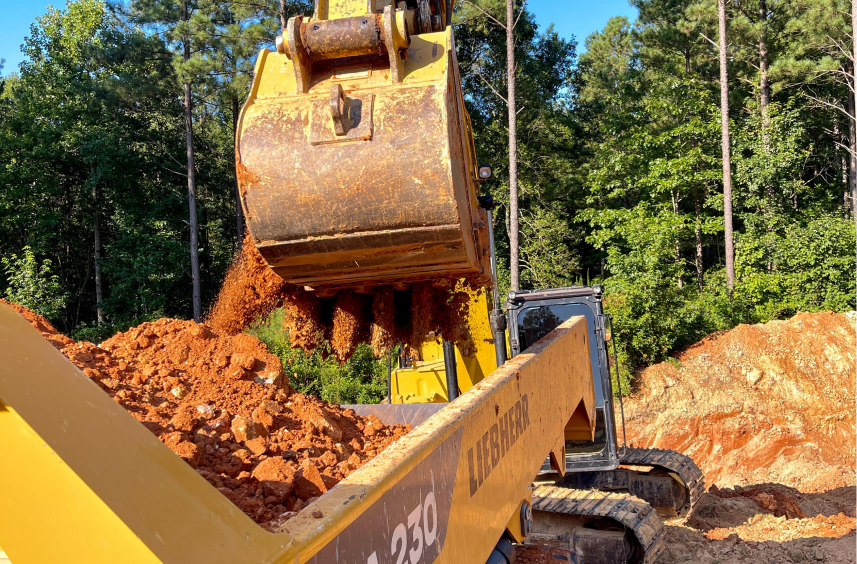
Our Mass Grading Process
Every mass grading project starts with a review of the engineered grading plan. We work from civil drawings to understand design elevations, drainage patterns, and cut-fill balance. GPS machine control on our dozers and motor graders allows us to track real-time cut and fill volumes and deliver finished elevations within tolerance. Mass grading is typically preceded by land clearing and followed by fine grading before construction begins.
Equipment Used in Mass Grading
Our equipment includes large track bulldozers for bulk cut and push, motor graders for rough and finish grading passes, track excavators for precision digging, compactors for lift-by-lift fill compaction to spec, and a fleet of dump trucks for material movement across the site.
Serving Central NC — Montgomery, Stanly, Moore, and Randolph Counties
The clay-heavy soils of the Central Piedmont present specific challenges — high shrink-swell potential and moisture sensitivity during wet weather. Our operators have extensive experience managing these conditions across Montgomery County, Stanly County, Moore County, and Randolph County. Request a site assessment and quote.
Common Questions About Mass Grading in Central NC
What is cut and fill, and why does it matter?
Cut and fill refers to removing earth from high areas (cuts) and using it to build up low areas (fills) to achieve design elevations. A well-balanced cut-fill operation minimises the need to import or export material, which controls cost significantly.
Does mass grading require engineered plans?
For any commercial development or subdivision, yes. A civil grading plan prepared by a licensed engineer is required before mass grading begins. For residential projects without formal engineering, we can grade to a building pad elevation based on site conditions.
How does wet weather affect mass grading in NC?
Clay-heavy soils become unstable when wet and can be permanently damaged if worked in the wrong conditions. Our operators know when to work and when waiting a day saves a week of remediation.
Can you handle both mass grading and fine grading on the same project?
Yes — and it’s efficient to combine them. See our fine grading page for what follows mass grading before concrete or paving begins.
What compaction standards do you work to?
We compact to the specifications on the project’s geotechnical or civil plan — typically 95% of maximum dry density per ASTM D698 or D1557 for structural fills. Where density testing is required, we coordinate with the testing firm.

Developers

Manufacturing Facilities


Real Estate Developers